
Summer Guide Training
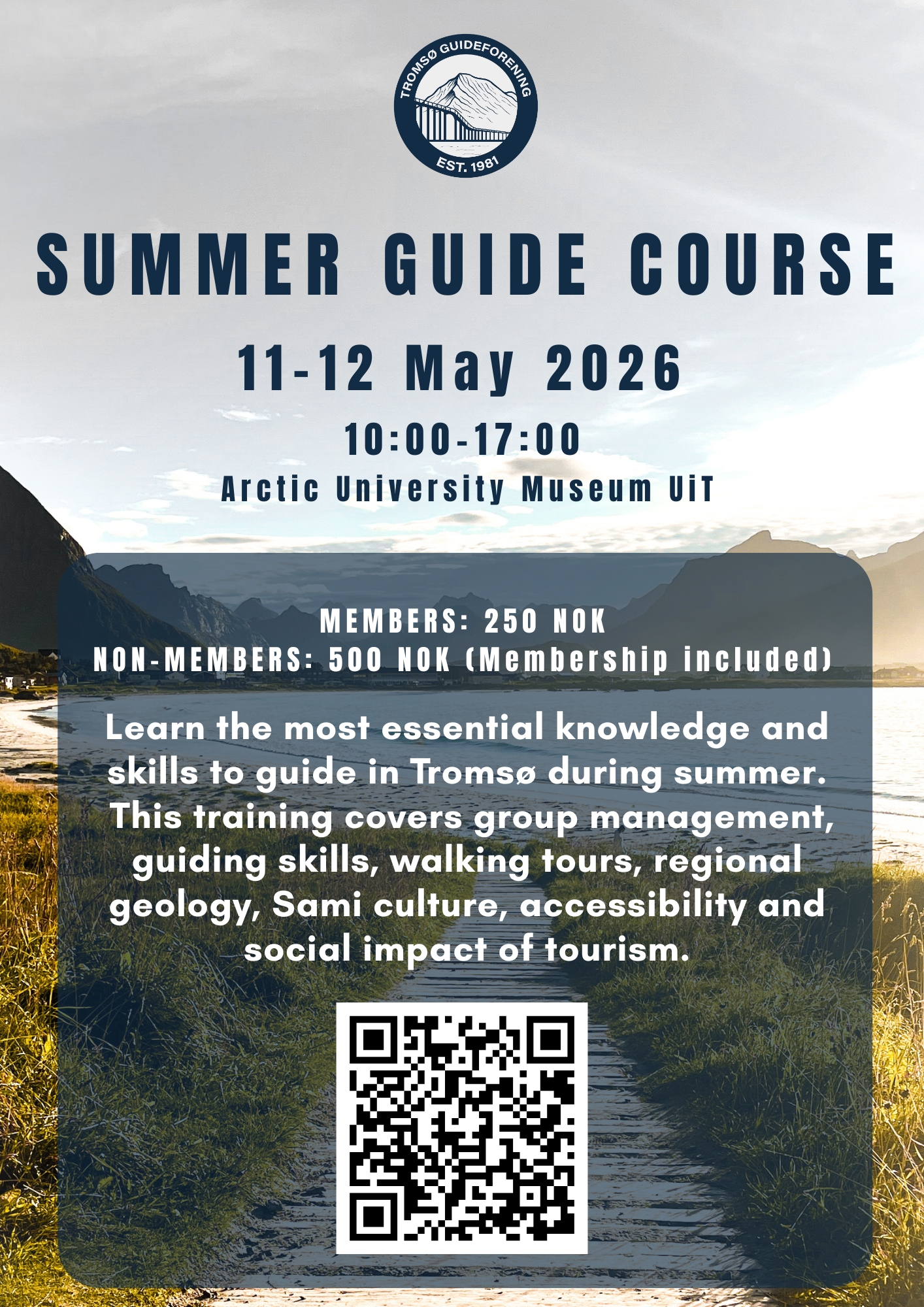
This 2-day training is designed to give you a foundation in what every guide in Northern Norway should know — from local culture and history to nature, fjords, and professional guiding skills.
NOTE: This training is a pilot program.
- Dates: 11–12 May 2026
- Time: 10:00 – 17:00 (both days)
- Location: Arctic University Museum of Norway
Price
- 500 NOK (for non-members – includes membership)
- 250 NOK (for existing members)
What will you learn?
This training combines essential knowledge with practical guiding skills:
- Professional guiding tools and techniques
- Communication and storytelling in guiding
- Introduction to Sámi culture and respectful interpretation
- Accessibility and inclusive guiding
- Understanding Tromsø, its history and identity
- Fjords, landscapes, and local geology
- Social impact and responsible tourism
- How to design and lead engaging city walks
- Real-life guiding scenarios and group management
Why join this training?
Guiding is more than just sharing information — it’s about creating meaningful experiences.
This course will help you to:
- Build confidence when speaking in front of groups
- Understand your role as a guide in a sensitive Arctic environment
- Gain a solid knowledge base about Tromsø and its surroundings
- Learn how to handle real situations with guests
Who is this for?
- Experienced guides who want to refresh or expand their knowledge and skills
- New guides who start guiding in Tromsø
- Seasonal workers in tourism, who want to know more about Tromsø
- Anyone interested in working as a guide in Tromsø
(The application form includes payment details.)
Recommended Extension:
Museum Guide Course at UiT
We highly recommend continuing your learning with this special course at UiT The Arctic University of Norway, taking place right after our Summer Guide Training.
Practical Information
- Date: 12 and 13May 2026
- Time: 16:30 – 21:00 (right after our course ends)
- Location: The Arctic University Museum of Norway, Tromsø
- Guide’s Code of ConductIntroduction Being a guide in Tromsø is more than taking guests from A to B. We are often the first and most direct contact visitors have with the destination, showing them the nature, communities, culture and everyday life of Northern Norway. At the same time, we work alongside other guides who face the same weather, traffic, difficult guests, crowded locations and pressures that come with the job. The Tromsø Guideforening Code of Conduct sets out the basic standards we expect from everyone participating in our community. Guiding is a competitive profession, but we share the same destination, workplaces and professional community. TGF wants to help create a guiding community where we can compete professionally without treating each other as enemies. This Code is about treating people with respect, putting safety first, protecting the places where we work and maintaining a positive and professional guiding community. The following is a short summary of the essential standards. The full Code of Conduct, including procedures for reporting concerns and handling serious or repeated breaches, is available below. Full Version 1. Scope of the Code This Code applies to: TGF members; guides participating in TGF activities, courses and events; people participating in TGF communication channels; people representing or acting on behalf of TGF. Some TGF communication channels may be open to guides who are not members. Participation in such channels is conditional on respecting the applicable rules.The Code does not attempt to regulate a person’s entire private life.TGF recognises that guides have personal opinions, friendships, professional relationships and activities outside the association.The important distinction is between how someone acts within TGF or on behalf of TGF and what they do in their private capacity. 2. Our basic principles As guides, we aim to: Respect people. Protect nature and the places where we work. Put safety before commercial interests. Cooperate with other guides. Respect local residents and communities. Represent Tromsø and the guiding profession positively. Be honest and professional. Take responsibility for our own actions. Resolve disagreements constructively whenever possible. Remember that we are colleagues, even when we work for competing companies. 3. Leave the place better than you found it This is one of the most important principles of TGF.Guides have a responsibility to protect the places where we work and bring visitors. Guides should: take all waste away; never leave toilet paper, food waste or other rubbish behind; avoid damaging vegetation; avoid creating unnecessary new trails; respect wildlife; follow local rules and restrictions; use established facilities where possible; respect fire restrictions and local conditions; leave campsites, viewpoints, beaches, trails and parking areas clean. Fires Where fires are permitted, guides must use appropriate methods that minimise damage.Fires should never be made directly on vegetation, bare ground, snow or ice when doing so can cause damage or contamination.Appropriate fire pans, established fire facilities or other suitable methods should be used where necessary.A fire must be properly extinguished and the area left clean. 4. We are ambassadors for Tromsø Guides are often the human face of the destination.Guests may remember a guide long after they have forgotten the name of the company they booked with. Our behaviour therefore contributes to how visitors perceive: Tromsø; Northern Norway; local communities; nature; local culture; and the guiding profession itself. We should therefore aim to provide visitors with an experience that is honest, respectful, safe and welcoming.This does not mean that every guide has to behave in exactly the same way or always agree with others.It means remembering that our behaviour reflects on more than just ourselves. 5. Respect for other guides Guides work under pressure and disagreements will happen.When another guide’s behaviour creates a problem, the preferred approach is to address the issue calmly and privately whenever reasonably possible. If you have a problem with another guide: speak to them directly where appropriate; move away from guests before discussing the issue; explain what the problem is rather than attacking the person; listen to their side; try to find a practical solution. In the field When several guides or groups arrive at the same location, guides should cooperate and share the space where reasonably possible.If a location cannot comfortably accommodate everyone, guides should communicate and find a practical solution.A guide should not deliberately take over or disrupt a location that another guide is already using. Guests come first Do not create conflicts in front of guests unless immediate safety requires intervention.Never deliberately undermine another guide’s presentation, relationship with guests or professional work.Friendly interaction between guides is, of course, welcome when it is appropriate and does not disturb another guide’s work. 6. Respect for local residents Tourism takes place in people’s homes and communities. Residents should never be treated as an inconvenience simply because tourism is taking place in the area. Guides should: avoid unnecessary noise; avoid blocking roads, driveways or access; respect signs and local restrictions; avoid unnecessary disturbance around homes and cabins; keep groups under control around residential areas; leave when a location is clearly causing unreasonable disturbance. Parking on or close to private property may sometimes be necessary, especially around areas with holiday cabins or limited parking. The important principle is: Do not unnecessarily obstruct people or prevent them from accessing their property. Where it is unclear whether parking is acceptable, asking the owner is often the easiest solution. Guides must comply with applicable parking, traffic, access and property rules. If a resident approaches a guide with a reasonable concern, the guide should respond calmly and respectfully. 7. Safety comes first No commercial interest justifies knowingly putting guests, guides, residents or others at unnecessary risk. Guides should: follow applicable laws and regulations; follow relevant safety procedures; assess risks appropriate to their activity; use appropriate equipment; know their own limits; take weather and environmental conditions seriously; intervene when necessary to prevent immediate danger. When safety is at stake, a guide should be prepared to help another guide or group, regardless of which company they work for. Professional competition must never come before safety. 8. Respect for culture and […]
Price: 500 NOK